

PM2.5, VOCs, and CO2 Bedroom Air Sensor Interpretation for Sleep

Why bedroom sensor numbers matter for sleep
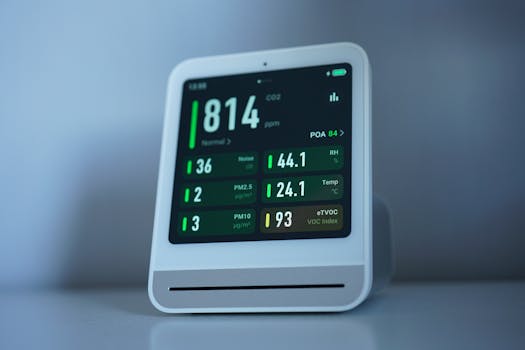
Bedroom air quality affects more than comfort. Fine particulate matter (PM2.5), volatile organic compounds (VOCs), and carbon dioxide (CO2) each relate to different sources and different health pathways. A modern bedroom air quality sensor can help you interpret what is happening in your room—especially at night when ventilation patterns, cooking residue, cleaning products, and occupancy are stable enough to trace.
Interpreting sensor readings correctly is crucial. Many sensors estimate concentrations using optical or electrochemical methods and may not perfectly match laboratory results. Still, the trends are often meaningful: rising CO2 usually reflects ventilation and occupancy; spikes in PM2.5 can track outdoor infiltration or indoor particle generation; VOC changes can reflect off-gassing from materials and episodic sources such as aerosols or cleaning agents.
This guide explains how to interpret PM2.5, VOCs, and CO2 readings for sleep, what values typically mean, and what practical actions can improve nighttime conditions without turning your bedroom into a constant science project.
How sensors measure PM2.5, VOCs, and CO2 (and why that matters)
Before focusing on “good” or “bad” values, it helps to understand what the sensor is actually sensing.
PM2.5: optical particle counting and indoor particle behavior
Most bedroom PM2.5 sensors use an optical method that estimates particle mass from how particles scatter light. This can be sensitive to particle size, composition, and humidity. For sleep interpretation, the key point is that PM2.5 readings often respond quickly to events (burning candles, cooking, nearby traffic, vacuuming) and that some sensors may show higher readings during humid conditions even if the actual mass is similar.
When you see PM2.5 drift upward slowly overnight, it may reflect infiltration from outdoors or persistent indoor sources. When it spikes suddenly, it often points to a discrete event.
VOCs: sensor-specific chemistry and common indoor sources
VOCs sensors usually detect a broad mixture of gases using metal-oxide, photoionization, or electrochemical approaches. They typically report “total VOCs” (TVOCs) or an index rather than identifying individual compounds. Because VOCs are diverse—solvents, fragrances, building materials, cleaning agents—the sensor can respond strongly to one product and weakly to another.
For sleep, VOC sensors are most useful for detecting changes: for example, whether a room “settles” after ventilation or whether a night-time source is continuously off-gassing.
CO2: ventilation proxy rather than pollution toxicity
CO2 sensors measure carbon dioxide concentration directly (often using nondispersive infrared or similar methods). CO2 in bedrooms is rarely a direct toxic threat at typical indoor levels, but it is a reliable proxy for ventilation adequacy. Higher CO2 generally means less fresh air per person, which can correlate with stale air, higher humidity, and increased exposure to other indoor contaminants that ventilation would dilute.
For sleep interpretation, the pattern matters: CO2 should generally rise after you enter the room and fall when you ventilate. If it stays high for long periods, the room may be under-ventilated.
PM2.5 for sleep: what readings usually indicate
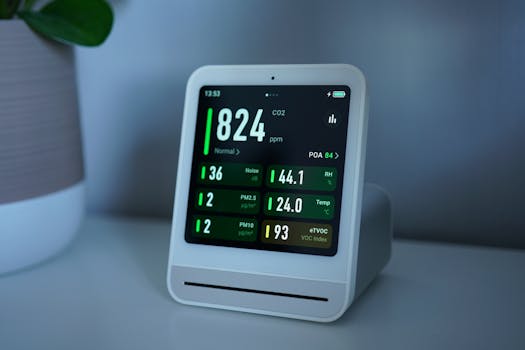
PM2.5 refers to particles smaller than 2.5 micrometers that can reach deep into the lungs. Bedroom exposure matters because you spend many hours breathing the air near your bed.
Typical ranges and how to think about them
Different sensors report in different units, but most display micrograms per cubic meter (µg/m³). In general, lower is better. A practical way to interpret PM2.5 for sleep is to look at:
- Baseline level: the reading when nothing unusual is happening (no cooking, no cleaning, windows closed for a while).
- Spikes: short increases that may correspond to an event or outdoor disturbance.
- Time above a threshold: how long concentrations remain elevated overnight.
If your sensor frequently shows elevated PM2.5 during sleep hours, it can be worth investigating outdoor infiltration (traffic, nearby construction, wildfire smoke) and indoor activities (smoking, candles, incense, certain cleaning methods, cooking).
Common bedroom causes of PM2.5 spikes
- Outdoor air intrusion: traffic pollution or seasonal smoke can enter through cracks and HVAC systems.
- Indoor particle generation: frying, grilling, stovetop cooking, frying oils, and some aerosol products.
- Resuspension: vacuuming, walking on dusty floors, or shaking bedding can lift particles.
- Humidity effects: some optical sensors read higher during humid periods due to particle growth or optical scattering changes.
When interpreting a nighttime spike, consider whether you had a recent cooking session, a smoke-producing event elsewhere in the home, or a ventilation change (e.g., HVAC cycling or window opening).
Practical steps to reduce PM2.5 exposure during the night
You don’t need to “chase” every micro-event, but you can lower risk by addressing the main pathways:
- Stabilize ventilation decisions: if outdoor PM2.5 is higher than indoor baseline, keep windows closed during the night and rely on filtration or HVAC with appropriate filtration.
- Remove particle sources before bedtime: avoid candle/incense use before sleep; manage cooking exhaust with proper range hood venting.
- Reduce resuspension: if you vacuum, do it well before bedtime and let the room settle.
- Use sensor-informed timing: if your PM2.5 reading drops after a ventilation or filtration change, note the time constant and aim to reach a stable low level before you go to bed.
For sleep interpretation, the goal is often not a single “perfect” reading, but a consistently lower baseline and fewer spikes during your main sleep window.
VOCs for sleep: interpreting total VOC trends and triggers
VOCs are a broad class of chemicals that can come from products and building materials. Some VOCs can irritate the eyes and airways, and some are associated with longer-term health concerns depending on identity and concentration. Bedroom sleep interpretation focuses on identifying whether VOCs are rising due to an ongoing source or falling after ventilation.
How to interpret TVOC-style readings
Many sensors report TVOCs in arbitrary units or in parts per billion equivalent. Because the sensor may not measure each compound accurately, the most reliable interpretation is usually relative:
- Look for direction: Are VOCs trending up after you enter the room, or are they trending down after ventilation?
- Identify “after source” behavior: Do readings spike after you use cleaning products, sprays, air fresheners, or new furnishings?
- Watch for settling time: How long after opening a window or changing HVAC settings does the VOC number decrease?
Even without exact thresholds, a VOC sensor can help you avoid sleeping during periods when the room is “freshly treated” with chemicals.
Common bedroom VOC sources
- Cleaning and disinfecting products: sprays, wipes, and solvents.
- Fragranced products: air fresheners, scented detergents, and fabric sprays.
- New materials and furnishings: off-gassing from foam, upholstery, adhesives, and paint.
- Cooking and household activities: some VOCs can linger after cooking, especially if exhaust is limited.
- Garage or laundry influence: VOCs from solvents, fuels, or dry-cleaning residue can migrate through shared ventilation.
If your VOC sensor shows higher readings at bedtime on certain days, it may correspond to laundry schedules, cleaning routines, or deliveries of new items.
Practical ways to lower VOC exposure at night
- Ventilate before sleep, not during: If you need to use sprays or cleaners, do it earlier in the day and ventilate until the VOC trend stabilizes downward.
- Prefer low-VOC routines: choose cleaning methods that minimize aerosolized chemicals and avoid fragranced products in the bedroom if you notice persistent spikes.
- Allow time for new items to off-gas: new furniture or bedding can release VOCs for weeks. Keep the bedroom ventilated during the initial period and monitor the sensor trend.
- Be cautious with “air freshening”: many products add VOCs rather than removing them, which can keep readings elevated.
For sleep interpretation, the best sign is a VOC number that declines after ventilation and stays low without recurring spikes.
CO2 for sleep: using CO2 as a ventilation and occupancy signal
CO2 accumulates when people exhale in a sealed or poorly ventilated room. Overnight, CO2 can rise progressively, especially if windows remain closed and HVAC ventilation is minimal.
What CO2 levels typically mean overnight
A common approach is to treat CO2 as a ventilation indicator rather than a direct toxicity measure. In many homes, CO2 may be near outdoor background levels in the morning after ventilation, then rises after you enter the room.
For sleep, the key interpretive questions are:
- How high does it get? Higher peaks suggest reduced ventilation.
- How fast does it rise? A fast rise can indicate very low air exchange.
- Does it fall after ventilation? If you ventilate and CO2 drops, that confirms ventilation is the main driver.
Different guidance documents use different numeric targets, but the practical takeaway is to keep CO2 from steadily climbing throughout the night.
Why CO2 can stay high even if the room feels “fine”
CO2 may remain elevated if:
- The door is closed: bedrooms often have limited airflow relative to the rest of the home.
- HVAC cycles are infrequent: ventilation may not supply enough fresh air during the night.
- Windows are sealed tightly: energy-efficient windows reduce air leakage.
- There are multiple occupants: more exhaled CO2 increases the concentration faster.
Because people adapt to “stale air” sensations, CO2 trends can provide information your comfort cues may not.
Practical ventilation strategies for CO2 control during sleep
- Use short, effective ventilation bursts: opening windows for a limited time before bed can reduce the starting CO2 and slow overnight accumulation.
- Consider background ventilation: if your HVAC has a “fresh air” or continuous ventilation mode, check whether it runs overnight.
- Balance with outdoor air quality: if outdoor PM2.5 is high, you may need to ventilate more strategically (e.g., timed ventilation when outdoor levels are lower) rather than keeping windows open all night.
- Track the time constant: note how long it takes CO2 to drop after ventilation and how quickly it rises after you settle in. That helps you choose a sustainable routine.
CO2 interpretation for sleep is about maintaining adequate ventilation without creating other issues like high PM2.5 infiltration.
Interpreting all three together: common patterns in real bedrooms
Sensor readings rarely change independently. Combining PM2.5, VOCs, and CO2 can help you identify what’s driving the air quality problem and which intervention is likely to help.
Pattern 1: CO2 rises, PM2.5 stays steady, VOCs stable
This often indicates under-ventilation with no major particle or chemical source. The most likely fix is improving fresh air exchange (or adding controlled ventilation) during sleep hours.
Pattern 2: PM2.5 spikes, CO2 rises normally, VOCs unchanged
That pattern suggests a particle event—either outdoor infiltration or an indoor particulate source—without a major ventilation or chemical shift. Consider what happened before the spike (cooking, cleaning, nearby activity, HVAC changes).
Pattern 3: VOCs spike after cleaning, CO2 rises slowly, PM2.5 low
This points to episodic chemical off-gassing from products. In that case, waiting for VOCs to fall and ventilating until the trend stabilizes is often more effective than focusing on CO2 or PM2.5 first.
Pattern 4: All three elevated after windows opened
Opening windows can reduce CO2 but may also increase VOCs (from outdoor sources) and PM2.5 (from outdoor pollution). If this pattern repeats, you may need to time ventilation for periods when outdoor air is cleaner or rely on filtration plus controlled ventilation.
Pattern 5: VOCs slowly decline over days, CO2 stable, PM2.5 stable
This suggests a persistent low-level off-gassing source that is gradually settling—common with new furniture, paint, or renovations. The sensor trend can help you decide when it is reasonable to treat the room as “settled” for sleep.
Common sensor pitfalls that lead to wrong conclusions
Even good sensors can mislead if you interpret them without context.
- Ignoring calibration and baseline: low readings from one sensor may not match another due to different algorithms and calibration.
- Overreacting to short spikes: a brief PM2.5 or VOC spike may not meaningfully affect your overall exposure during sleep, especially if it returns quickly to baseline.
- Assuming “total VOCs” identifies specific chemicals: TVOC-style outputs do not tell you which compound is present. A stable reading may still hide irritants, and a high reading may not correspond to the compounds you fear.
- Confusing CO2 with “air freshness”: CO2 is a ventilation proxy. Comfort can be affected by humidity, temperature, and other pollutants not captured by CO2 alone.
- Forgetting humidity and airflow effects: sensor performance can shift with humidity and airflow patterns, especially for optical particle sensors.
The best approach is to treat the sensor as a tool for trend recognition, then adjust the biggest controllable drivers: ventilation, particle sources, and chemical use timing.
How to set up a simple sleep-focused monitoring routine
You can get useful interpretation without running complicated experiments. The goal is to create a consistent observation window before making changes.
Step 1: Establish your overnight baseline
Choose several nights when you do not use sprays, do not cook close to bedtime, and keep routines consistent. Record:
- PM2.5 baseline and whether spikes occur
- VOC trend from evening to morning
- CO2 peak and how quickly it rises
Even a few nights can reveal whether your room is generally stable or whether you have recurring nighttime events.
Step 2: Change one variable at a time
For example, try ventilating for 10–20 minutes before bed and compare CO2 rise rate and overnight peak. Or, if you suspect particles, reduce indoor particle sources for a few days and compare PM2.5 patterns.
Because PM2.5 and VOCs can be influenced by both indoor and outdoor conditions, keep track of weather and outdoor events when possible (wildfire smoke, nearby traffic changes, construction).
Step 3: Use “settling time” as your decision rule
For VOCs, settling time is often the most actionable metric. If VOCs remain elevated after ventilation, you may need longer airing time or a different routine that avoids the triggering product.
For PM2.5, settling time after filtration or after a ventilation change can indicate whether your bedroom air clears quickly enough to make nighttime conditions favorable.
Prevention and risk reduction: actionable guidance for healthier sleep
Sensor interpretation should lead to practical prevention. The most effective strategies are usually those that reduce sources and improve dilution/filtration in a targeted way.
Reduce particle sources before bedtime
- Keep candles, incense, and smoking out of the bedroom.
- Use proper kitchen exhaust during cooking and allow time for air to clear before sleep.
- Vacuum and dust on a schedule that does not immediately precede bedtime.
Manage ventilation without importing outdoor pollution
- When outdoor PM2.5 is high, prioritize indoor filtration and controlled ventilation rather than leaving windows open.
- When outdoor air is cleaner, timed ventilation can reduce CO2 and help VOCs dissipate.
Lower VOC contributions from daily routines
- Avoid fragranced sprays and heavy air fresheners in the bedroom.
- Ventilate after cleaning and allow products to fully dissipate before sleep.
- During periods of new-furniture off-gassing, keep the room ventilated and monitor VOC trend stability.
Use sensor data to support decisions, not to create anxiety
Air quality is dynamic. A single high reading does not automatically mean you are exposed at harmful levels for the whole night. Instead, focus on patterns: whether CO2 is steadily rising, whether PM2.5 regularly spikes, and whether VOCs remain elevated after you would expect them to clear.
If you are using devices that display PM2.5, VOCs, and CO2 in one dashboard—such as smart air monitors that report these metrics in real time—the most useful habit is to review the evening-to-morning trend rather than checking numbers at random times.
Summary: turning PM2.5, VOCs, and CO2 readings into sleep-ready decisions
To interpret bedroom air quality sensor readings for sleep:
- CO2 mainly reflects ventilation and occupancy. Aim to prevent CO2 from climbing throughout the night; ventilate strategically to reduce the starting level and slow overnight accumulation.
- PM2.5 reflects particle exposure from outdoor infiltration or indoor events. Focus on baseline stability and the frequency of spikes during sleep hours.
- VOCs reflect chemical off-gassing and product-related triggers. Use VOC trend and settling time to decide when the room is ready for sleep after cleaning, new items, or other sources.
When you interpret these metrics together, you can usually identify the dominant driver—under-ventilation, particles, or chemical sources—and respond with targeted changes. Over time, your sensor data becomes a practical guide for building a bedroom routine that supports cleaner air and more restful sleep.
02.04.2026. 23:14