

Joint-Friendly Warm-Up for Desk Workers: Neck, Thoracic, Hip Mobility

Goal: wake up neck, thoracic spine, and hips without irritating joints

Long hours at a desk often leave the neck stiff, the upper back rounded, and the hips under-mobilized. The goal of this routine is to restore gentle movement through the joints and tissues you use most—without forcing end ranges or turning warm-up into a workout that leaves you sore. You’ll move in small, controlled ranges, gradually increase mobility, and finish with stability so your body can transition smoothly from sitting to standing or training.
This is a joint-friendly warm-up routine for desk workers neck thoracic hip mobility that you can complete in about 15–25 minutes. It works especially well before walking, strength training, yoga, or any day where you want your posture and range of motion to feel more accessible.
Preparation: set up your space and choose the right intensity
Before you start, make the routine easy to follow and safe for your joints.
- Time: 15–25 minutes.
- Space: enough room to stand and move your arms and legs without hitting furniture.
- Surface: a mat helps for kneeling and floor work, but you can use a towel.
- Support (optional): a chair for balance and a wall for stability.
- Comfort tools (optional): a lacrosse ball or small therapy ball for light upper back/shoulder blade release and a foam roller for thoracic extension. Use them gently—warm-up should not turn into deep tissue pain.
- Intensity rule: aim for “comfortable effort.” You should feel the movement, but not joint pinching, sharp pain, or aggressive stretching.
- Breathing: use slow nasal breathing when possible. Exhale during the easier part of the movement to encourage ribcage control.
If you have a history of neck injury, disc symptoms, severe shoulder pain, or hip joint problems, keep ranges smaller and prioritize pain-free motion. If any drill causes sharp or radiating pain, stop and reduce range or swap to a more supported version (like doing the movement at a wall).
1) Start with circulation and posture reset (1–3 minutes)

Begin by raising body temperature and setting a neutral, stacked posture. This reduces the chance you’ll compensate with the neck or low back during mobility drills.
- Stand tall with feet hip-width apart, knees soft, and ribs stacked over pelvis.
- Slow shoulder rolls: roll shoulders back and down for 6–8 reps.
- Chin tuck glide: gently slide your chin straight back (like making a double chin) without looking down. Hold 1 second, relax. Do 6–8 reps.
- Arm reach with tall spine: reach your fingertips up and slightly out, then exhale and return to neutral. Do 6 reps.
How it should feel: “wake-up” movement, not stretching. If the neck feels irritated, keep the chin tuck smaller and slow.
2) Joint-friendly neck mobility: control side-bending and rotation (3–5 minutes)
Neck mobility for desk workers should emphasize smooth, controlled motion with the jaw relaxed and shoulders down. You’re preparing the cervical spine and the muscles that stabilize it, not stretching aggressively.
- Seated or standing neck side-bend:
- Keep shoulders relaxed.
- Gently tilt your ear toward one shoulder until you feel a mild stretch on the opposite side.
- Stop before pain or “pinch.”
- Return to center and repeat on the other side.
- Neck rotation with “stop at the edge” control:
- Turn your head to the right until you feel a mild end-range sensation.
- Hold 1 second while keeping your chest facing forward.
- Return to center, repeat left.
- Shoulder blade coordination (optional but helpful):
- As you rotate, lightly depress the shoulder on the moving side (think “shoulders stay away from ears”).
Common mistake: turning the whole upper body instead of the neck. Keep your torso quiet.
Optimization: if you feel clicking or tightness, slow down and reduce the rotation range. Smooth motion beats bigger range during warm-up.
3) Thoracic spine mobility: open the “rounded upper back” pattern (5–8 minutes)
Thoracic mobility is often the missing link for desk posture. When the mid-back is stiff, the neck and low back tend to compensate. These drills aim for controlled extension and rotation with joint-friendly positioning.
- Foam roller or towel thoracic extension (supported):
- Lie on your back with a foam roller (or rolled towel) under the upper back.
- Support your head with your hands, elbows wide.
- Exhale as you gently extend over the roller, then return to neutral with control.
- Thread-the-needle thoracic rotation (on all fours):
- Start on hands and knees.
- Reach one arm under your body, then rotate your chest toward the floor.
- Keep hips stable; you’re rotating the thoracic spine.
- Return to start and switch sides.
- Open book rotation (side-lying):
- Lie on your side with knees bent.
- Keep hips stacked and rotate the top arm open as far as is comfortable.
- Pause 1 second at the “easy edge,” then return.
How it should feel: a sense of opening across the mid-back and between the shoulder blades, not sharp discomfort in the shoulder joint.
Common mistake: forcing the movement by yanking the neck. Keep your gaze neutral and follow your arm with eyes only as needed.
Optimization: if thoracic extension feels limited, do fewer reps but increase control—try 6 slow reps with perfect positioning instead of 12 rushed ones.
4) Hip warm-up: restore mobility without joint compression (5–8 minutes)
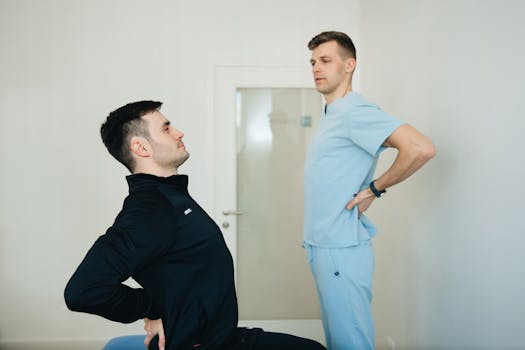
Desk work often tightens hip flexors and reduces hip rotation capacity. The warm-up here focuses on moving the hip through comfortable ranges and improving pelvic control, so you don’t feel “pinchy” at the front of the hip.
- 90/90 hip switches (gentle):
- Sit on the floor with one leg in front (knee bent, shin roughly forward) and the other leg out to the side.
- Keep your torso tall.
- Shift weight slightly and switch legs smoothly.
- Hip flexor rock-back (supported kneeling):
- Kneel with one knee down and the other foot forward (like a lunge).
- Place a hand on a chair or wall for balance.
- Tuck your pelvis slightly (think “shorten the front of the hip”).
- Rock your hips back a few inches until you feel mild stretch at the front of the hip.
- Return to start.
- Glute bridge with controlled exhale:
- Lie on your back, knees bent, feet under knees.
- Exhale and lift hips until you feel glutes engage.
- Pause 1 second, then lower with control.
Common mistake: arching the low back during bridges or rocking too far in the hip flexor drill. Keep ribs down and movement smooth.
Optimization: if you feel pinching in the front of the hip during kneeling, shorten the range and focus on pelvic control first. The goal is “comfortable mobility,” not maximum stretch.
5) Integrate mobility with stability: neck, thoracic, and hips working together (3–5 minutes)
Mobility alone doesn’t always translate to better movement. This step connects your mid-back, pelvis, and head/neck control so you stand and move with less compensation.
- Quadruped rocking with thoracic rotation option:
- Start on hands and knees.
- Rock gently forward and back while keeping your neck long (no aggressive chin jutting).
- After 3–4 rocks, add a small thoracic rotation: shift your weight and rotate your chest slightly toward one side.
- Half-kneeling reach with pelvic control:
- Half-kneel (one knee down), tall spine.
- Exhale to gently tuck pelvis (avoid rib flare).
- Reach one arm overhead and slightly rotate open through the thoracic spine.
- Return to center.
- Standing hip hinge with neutral neck:
- Stand with feet hip-width.
- Hands on hips or hold a wall lightly.
- Hinge at hips, keeping spine long and neck neutral.
- Return to standing using glutes.
How it should feel: your head feels “stacked,” your mid-back moves smoothly, and your hips guide the motion without low-back dominance.
6) Finish with a short “get ready to move” reset (1–2 minutes)
Close the routine by reinforcing the posture and motion you just practiced. This helps you carry mobility into your next activity.
- Standing posture reset:
- Feet grounded.
- Exhale and let ribs soften down.
- Gently retract chin (small, not forced).
- Light marching in place:
- March slowly for 30–45 seconds.
- Keep neck relaxed, eyes forward.
- Let your thoracic spine stay tall as you move.
If you’re about to lift weights or go for a walk, this finish helps your nervous system choose the improved positions.
Common mistakes that reduce results or irritate joints

- Going too hard on stretching: warm-up should feel like “prepping,” not forcing. If you feel sharp pain, stop and reduce range.
- Neck dominance: many people use neck movement to “find” mobility. Keep the torso stable during cervical drills.
- Low-back compensation during thoracic extension: if you feel it in the lumbar spine instead of mid-back, adjust the roller/towel position higher and use smaller extension.
- Shoulder shrugging during rotation drills: keep shoulders away from ears, especially in open book and thread-the-needle.
- Hip flexor stretching that turns into front-of-hip pinching: shorten the range, focus on pelvic tuck, and choose supported variations.
- Rushed transitions: moving quickly between drills can make you lose control. Move with deliberate tempo.
Additional practical tips and optimisation advice
Use these adjustments to make the routine work better for your body and schedule.
- Match the routine to your day:
- Before desk work: do a shorter version (neck side-bend + open book + hip flexor rock-back + bridge).
- Before training: keep all steps and add 1–2 extra rounds of glute bridges or half-kneeling reaches.
- Choose mobility volume, not intensity: if you’re tight, increase reps slowly (e.g., +1–2 reps per drill). Don’t increase stretch force.
- Use a wall for balance if hips feel unstable: in kneeling hip flexor rock-backs and half-kneeling reaches, light contact with a wall can prevent compensation.
- Keep the neck quiet during thoracic work: for foam roller extension and thread-the-needle, avoid cranking the head. Let the thoracic spine do the work.
- Light release can help, but keep it gentle:
- If you use a therapy ball, spend 30–60 seconds on upper back/shoulder blade tissue and then immediately return to mobility drills.
- A foam roller is useful for thoracic extension; avoid aggressive rolling of the neck or directly on the front of the throat area.
- Track one simple outcome: after the routine, notice whether turning your head feels smoother, whether you can reach overhead with less restriction, and whether standing up feels less “stuck” through the hips.
- Progress in a joint-friendly way: when a drill feels easy, progress by increasing control (slower reps, longer holds) before increasing range. For example, pause 2 seconds at the “easy edge” in open book before trying to rotate further.
If you want to build consistency, attach this routine to a habit: after you get up from your desk, before your next meeting, or before you start any training session. Over time, the biggest improvements usually come from repeating the same joint-friendly movements with good control rather than changing everything every day.
Optional variations to fit different bodies
These alternatives keep the same intent while adjusting comfort and joint tolerance.
- Neck rotation discomfort: reduce range and add a short chin tuck glide between rotations.
- Thoracic extension sensitivity: replace foam roller extension with seated thoracic extension over a chair back (hands on head, small extension only).
- Thread-the-needle too intense: widen your base on all fours and rotate smaller. You can also do it with hands on a bench for elevation.
- Hip flexor rock-back too hard on the knee: place a folded towel under the kneeling knee and keep the pelvic tuck smaller.
- 90/90 switches uncomfortable on the floor: do a standing hip mobility drill by gently shifting weight and moving into comfortable hip rotation without deep knee positions.
Choose the variation that allows smooth, pain-free movement. That’s the most joint-friendly path to better mobility.
03.12.2025. 00:06