

Progressive Overload for Beginners: Build Strength Safely

What progressive overload means (in plain language)

Progressive overload is one of the simplest ideas in strength training: to keep getting stronger, your training has to gradually become a little more challenging over time. That “more challenging” part can come from several places—more weight, more reps, better form with the same load, or doing the same work with less rest.
For beginners, the key is not to chase big changes every workout. Instead, think of progressive overload as a gentle, repeatable process. You do a workout, you recover, you repeat it, and you make it slightly harder when your body is ready.
When you do this consistently, your muscles and nervous system adapt. When you don’t—when you always do the same thing with no changes—progress often slows down because your body has already “learned” that level of effort.
The core idea: your body adapts to your training
Your muscles adapt to the specific demands you place on them. If you lift a weight, your body responds by improving how it can handle that movement. Over time, your body gets better at producing force, coordinating the movement, and tolerating fatigue.
Progressive overload simply means you keep finding a new challenge that is still realistic. The challenge should be just enough to drive adaptation, but not so big that your form breaks down or you can’t recover.
Key terms you’ll hear (and what they actually mean)

You don’t need to memorize jargon, but a few terms help you follow your own training.
- Volume: how much work you do. Often measured by sets and reps (for example, 3 sets of 10 reps).
- Intensity: how hard the work is. Commonly relates to how heavy the weight feels for your reps.
- Reps: how many times you do a movement in a set.
- Set: a group of reps performed back-to-back.
- Rest: time between sets. Rest affects how challenging the workout feels.
- RPE (effort level): a simple way to rate how hard a set felt, like “this set was challenging but I could do a bit more.” You can use it without any special tools.
- Failure: pushing until you can’t complete another rep with good form. For beginners, it’s usually better to avoid training to true failure most of the time.
How progressive overload works in real training
Progressive overload isn’t one single method. It’s a strategy that uses small, controlled changes. Here are the most common ways beginners can apply it.
Increase weight gradually
This is the classic approach. If you used a dumbbell that felt like a solid challenge last week, you try a slightly heavier dumbbell next time—only if you can keep good form and hit your target reps.
For example, if you can do 3 sets of 10 reps with a certain weight, you might move up the next time and aim for fewer reps at first. That’s still progressive overload because the load is higher.
Add reps while keeping the weight the same
If jumping weight feels too soon, you can keep the same weight and build rep count over time. When you can add a few reps per set (or reach your top target range), you then increase the weight.
This method is helpful when you’re unsure what your next weight should be, or when equipment changes are limited.
Use more sets (carefully)
Adding a set can raise training volume without immediately changing weight. Beginners often benefit from doing a small number of sets per exercise and then adding gradually as recovery allows.
For instance, if you’re doing 2 sets of an exercise, you might move to 3 sets once the movement feels consistent and recovery stays manageable.
Shorten rest a little
You can also make a workout harder by reducing rest time. This tends to increase the “burn” and fatigue of a set. Because fatigue can affect form, use this option conservatively.
A good beginner approach is to keep rest fairly consistent at first, then experiment with small changes only when technique is stable.
Improve form and control at the same load
Sometimes the “overload” is not obvious in the numbers. If you can repeat the movement with better control—slower lowering, more stable positioning, cleaner range of motion—that still counts as progress. Over time, better control often makes it easier to handle more weight or more reps.
How to track progress without making it complicated
Progressive overload works best when you can see what you did last time. You don’t need fancy software. A simple notebook or notes app is enough.
For each exercise, write down:
- the weight (or resistance)
- the reps you completed for each set
- how the sets felt (for example, “left 2 reps in the tank”)
This helps you know when you’re ready to increase something. Without tracking, it’s easy to accidentally repeat the same effort level for weeks.
Common beginner mistakes and misunderstandings
Progressive overload sounds simple, but beginners often get stuck because they misunderstand what “progress” should look like.
Thinking you must add weight every workout
Beginners often feel pressure to increase load constantly. In reality, your body may need several sessions to adapt to a new weight. Sometimes you’ll keep the same load for a few weeks and add reps or sets instead.
Progress comes from the trend over time, not from a perfect jump every session.
Going too hard too soon
It’s possible to overload yourself in a way that harms recovery. If you’re always training so hard that you can’t move normally the next day, your progress may stall because you’re not recovering well enough to adapt.
A beginner-friendly rule is to stop sets with good form while you still have a little energy left. That way, you can repeat the workout and build from there.
Ignoring technique and chasing numbers
If your reps look sloppy, your joints and muscles may not be getting the stimulus you think you’re getting. Also, poor form makes it harder to know which change is causing progress.
When you apply progressive overload, keep your technique consistent. If reps start turning into half-reps or your posture collapses, that’s a sign to adjust the load or slow down.
Changing too many things at once
Beginners sometimes switch exercises, change rep ranges, alter rest times, and increase weight all in the same week. That makes it hard to tell what worked and what didn’t.
Try to change only one main variable at a time. That keeps progress predictable and reduces frustration.
Overloading every muscle group equally every day
Strength training is demanding, and your body needs recovery. A common beginner mistake is training the same muscle groups hard every day. That can lead to soreness that never fully clears.
Instead, spread your training across days and let your body adapt. You can still progress without hammering everything daily.
Simple getting-started guidance for first-time users
If you’re new, the best place to start is with a plan that’s easy to repeat. Progressive overload becomes much simpler when you know what you’re trying to do each session.
Pick a few basic movements you can practice
Choose exercises that are stable and repeatable. Beginners often do well with a mix of:
- Lower body: squat pattern (goblet squat), hinge pattern (hip hinge), or step-ups
- Upper body push: push-ups or dumbbell presses
- Upper body pull: rows with dumbbells or a cable machine, or assisted pull-downs
- Core: dead bug variations, planks, or cable/pallof press if available
Consistency matters. You’ll progress faster by repeating the same movements than by constantly swapping exercises.
Start with a rep range that’s comfortable to build
A simple beginner rep range is often around 8–12 reps per set. It’s wide enough to allow growth, and it’s easier to keep form solid.
Use a weight that feels like you could do a couple more reps with good form. If you’re unsure, aim for sets that feel challenging but not chaotic.
Use a “reps first” approach to overload
Here’s a beginner-friendly way to apply progressive overload without guessing too much:
- Pick a weight and do your target reps for each set.
- When you can hit the top of your rep range for all sets with good form, increase the weight next time.
- If you can’t reach the top yet, keep the weight the same and try to add a rep or two over the next session(s).
This naturally creates progression and reduces the chance you jump too far too fast.
Example structure for your first 4 weeks
You can start with 2–3 training days per week. Each session can include 4–6 exercises. Keep the plan simple and repeat it.
One straightforward setup is:
- Lower body: 1–2 exercises
- Upper body push: 1 exercise
- Upper body pull: 1 exercise
- Core: 1 exercise
For each exercise, do 2–3 sets. Start with a weight that lets you complete your reps with good technique. Then use the “reps first” rule to decide when to increase weight.
As weeks go on, you might see your reps rise, then your weight go up. That’s exactly what progressive overload looks like for beginners.
How to know when to increase something
You’re looking for signs that your training is adapting. A few practical indicators:
- You can complete your target reps for all sets with consistent form.
- You feel less “stuck” at the same weight than you did earlier.
- Your effort level feels similar or slightly easier than before (without you changing your plan).
When those happen, increase one variable next session—most often weight, or reps if weight jumps are too big.
What to do if you miss reps or feel unusually sore
Missing reps doesn’t mean you failed. It often means your load was slightly too ambitious or your recovery wasn’t ideal.
For beginners, a simple response is to:
- reduce the weight next time
- or keep the weight the same but aim for fewer reps
- or add extra rest between sets
The goal is to keep the training moving forward while staying consistent.
Where equipment fits in (and how to use it for progressive overload)
You can do progressive overload with nearly any setup. The “technology” here is really how you measure resistance and keep your workouts repeatable.
Dumbbells and barbells
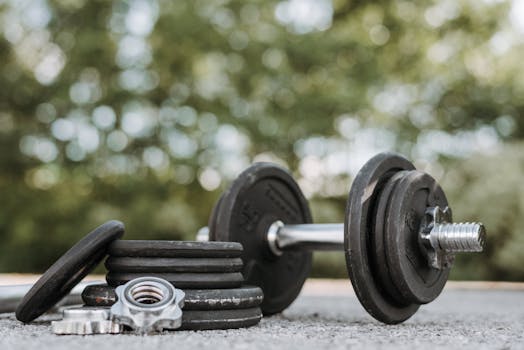
Free weights make it easy to increase load gradually, especially if your gym has small weight jumps. If you’re at home, adjustable dumbbells can help because they let you fine-tune weight without waiting for big jumps.
When you can hit your rep targets for all sets, move up to the next available weight.
Resistance bands
Bands don’t have a perfect number like “20 pounds,” but you can still use progressive overload. You can increase tension by changing how far you stretch the band, changing band size, or using a different band.
Track your setup: which band you used, how you anchored it, and roughly how many reps you completed. Then try to add reps or slightly increase tension over time.
Machines and cables
Machines and cable systems often make progression straightforward because the resistance is clearly adjustable. You can keep your form consistent and add weight when you meet your rep targets.
If you’re new to a machine, spend a little extra time learning the movement pattern first. A stable setup helps your overload be safer and more effective.
Putting it all together: a simple progressive overload plan

Here’s a beginner-friendly approach you can start with right away:
- Choose 4–6 exercises you can repeat.
- Do 2–3 sets per exercise.
- Pick a rep range like 8–12.
- Use a weight that feels challenging but controlled.
- Track sets and reps each workout.
- When you hit the top of your rep range for all sets with good form, increase the weight next time.
- If you don’t hit the top yet, keep the weight and try to add a rep or two over subsequent sessions.
This approach creates progressive overload without needing complicated calculations. It also builds confidence because you always know what you’re trying to improve.
How fast you should progress (and why it varies)
Progress can be quick at first, especially in the first few weeks, because your body is learning the movements. After that, progress often becomes slower and more gradual. That’s normal.
Factors that affect your pace include sleep, nutrition, stress, and how consistently you train. If you’re progressing slower than you expected, the solution is usually better recovery and more consistent training—not random intensity changes.
Think in terms of months, not days. Progressive overload is designed for long-term improvement.
11.05.2026. 05:30