

Personal Experiment Case Study Template: A Practical Guide

Why a personal experiment case study matters

A personal experiment can be as small as testing a study routine for two weeks or as structured as tracking how changes in sleep, nutrition, or training affect measurable outcomes. The difference between a fleeting attempt and useful knowledge is documentation. A personal experiment case study turns your experience into a readable record: what you tried, why you tried it, what happened, what you learned, and what you would change next time.
This article provides a personal experiment case study template you can reuse. It is designed for educational clarity—so your future self can interpret the results and so another reader can understand the logic behind your methods. You’ll also learn how to capture data consistently, analyze results without overclaiming, and present uncertainty honestly.
Overview of the personal experiment case study template
Use the template below as a structured outline. Not every section will fit every experiment, but the sequence is intentionally practical: start with goals and context, then define methods, then document data, then interpret results, and finally extract lessons. Each section includes guidance on what to write and what to avoid.
- 1) Experiment snapshot: a short summary of what you did and the outcome.
- 2) Background and motivation: why this question matters to you and what you already know.
- 3) Objective and hypotheses: what you expected and how you’ll judge success.
- 4) Variables and boundaries: what you changed, what you measured, and what you kept stable.
- 5) Materials and method: how you ran the experiment step-by-step.
- 6) Data collection plan: what data you captured, how often, and how you handled missing entries.
- 7) Results: facts first—numbers, observations, and timelines.
- 8) Analysis and interpretation: what the data suggests, what it cannot prove, and alternative explanations.
- 9) Risks, ethics, and safety notes: especially relevant for health, finance, or behavior experiments.
- 10) Lessons learned and next iteration: concrete adjustments for the next run.
When you write in this order, it becomes much easier to separate “what happened” from “what I think it means.”
Section 1: Experiment snapshot (write this last, but place it first)

The snapshot is a short paragraph (or a few bullet points) at the top of your case study. It helps the reader quickly identify the experiment and outcome without scanning the whole document.
Include:
- Topic: what behavior, habit, tool, or condition you tested.
- Time window: start date, end date, and total duration.
- Scale of effort: how much time or cost was involved (even if it’s “minimal”).
- Primary outcome: the main metric you tracked.
- Bottom-line result: improvement, no change, mixed results, or unexpected effects.
Keep it factual. Avoid explanations here; you’ll earn interpretation in later sections.
Section 2: Background and motivation—set context without bias
In this section, explain what led you to run the experiment. The goal is not to justify the outcome; it’s to help readers understand the conditions you started with.
Write:
- Your starting point: baseline experience, relevant constraints, or prior attempts.
- What you believed beforehand: the idea you were testing, even if it was informal.
- Why now: timing matters (new schedule, new goal, seasonal effect, life changes).
- Constraints: time, budget, equipment, access to data, or limitations in your environment.
Tip: If you already know the result, try to phrase background in the past tense and avoid language like “I knew it would work.” The case study should read like a record, not a persuasive essay.
Section 3: Objective and hypotheses—define success before you run
A useful personal experiment case study treats objectives like a measurement contract. You’re telling yourself (and the reader) what you will treat as evidence.
For educational clarity, include:
- Primary objective: one sentence describing the goal.
- Hypothesis: a testable expectation (even if simple).
- Success criteria: what level of change counts as meaningful for you.
- Secondary outcomes: additional effects you might notice (energy, mood, focus, fatigue, error rate).
Example of success criteria wording (adapt to your situation): “If average focus ratings increase by at least 1 point on a 1–10 scale and remain stable for at least 10 days, I will treat the intervention as promising.”
Avoid absolute language. Personal experiments often involve many uncontrolled factors, so success criteria should be realistic and time-bound.
Section 4: Variables and boundaries—separate “cause” from “noise”

This section prevents the most common documentation error: describing a change without defining what you changed or what you measured.
List your variables explicitly:
- Independent variable: the change you introduced (e.g., earlier bedtime, a new note-taking method, a specific training plan, a dietary adjustment).
- Dependent variables: what you measured or rated (e.g., sleep duration, performance score, symptom severity, study output, daily steps).
- Confounding variables: other factors that may change during the same period (stress, workload, travel, illness, major schedule shifts).
- Boundaries: what you did not change (e.g., same schedule, same workload, same caffeine timing).
Practical guidance: If you can’t keep everything stable, reduce ambiguity. For instance, if workload changed, record it. If you changed more than one variable, label them as “bundled intervention” or split them into phases if possible.
Section 5: Materials and method—describe the procedure so it can be repeated
A strong case study is reproducible in principle. You don’t need to provide every personal detail, but you do need enough method clarity that someone could understand how you ran it.
Include:
- Tools and materials: apps, trackers, journals, spreadsheets, wearable devices, or templates you used. Mention specific categories rather than brand hype.
- Setup: how you prepared before starting (baseline measurements, calibration, instructions to yourself).
- Procedure: step-by-step. If the method is simple, write it in chronological steps.
- Duration and schedule: start/end dates, daily/weekly cadence, and any rest days or washout periods.
- Adherence rules: what counted as “following the plan” versus “skipping.”
Where helpful, you can reference common productivity or tracking tools naturally. For example, if you used a habit tracker, you might describe it as “a daily check-in logged at the same time each evening.” If you used a wearable, note what metrics were available and how you handled missing readings.
Section 6: Data collection plan—make measurement consistent
Results are only as trustworthy as the way you measured them. This section should explain your data collection approach in plain language.
Document:
- What data you collected: primary metric, secondary metrics, and qualitative notes.
- How you collected it: manual entry, device readings, time logs, checklists, or surveys.
- Frequency: daily, weekly, per session, or at specific time points.
- Timing standardization: e.g., ratings at the same hour, measurements before meals, or after a consistent routine.
- Scale definitions: if you used a 1–10 rating, define what each end means.
- Handling missing data: what you did when you forgot, when readings failed, or when you skipped days.
- Data recording quality checks: how you prevented mistakes (double-checking entries, using templates, consistent naming).
Practical suggestion: include a brief “data integrity” statement. For instance: “If a day’s rating was missing, I marked it as blank and excluded it from the average rather than imputing a value.” You don’t need advanced statistics, but you do need to be transparent.
Section 7: Results—report facts before interpretation
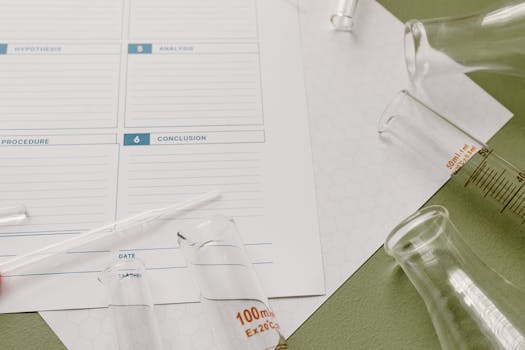
This section is where you show what happened. Keep it structured and chronological, especially if your experiment has phases (baseline, intervention, follow-up).
Write results in layers:
- Timeline: key dates and events (start, changes, disruptions, end).
- Primary outcome: the main metric over time or summarized totals.
- Secondary outcomes: supporting metrics and notable patterns.
- Qualitative observations: what you noticed that numbers may not capture.
- Adherence and deviations: how often you followed the plan and where it broke down.
Avoid mixing explanations into the results. If you want to say, “I think the change helped because…,” save that for analysis.
If you include numbers, you can summarize without forcing a table. A short list can be enough: averages, ranges, and count of days measured. Where relevant, note variability (e.g., “improved most on weekdays”).
Section 8: Analysis and interpretation—what the data supports (and what it doesn’t)
Analysis is where you earn credibility by being careful. Personal experiments are vulnerable to hindsight bias, selection effects, and confounding variables. Your job is to interpret responsibly.
Consider these analysis components:
- Compare to baseline: if you had a baseline period, explain how the change differed.
- Look for patterns: trends over time, consistency, and whether effects appear immediately or gradually.
- Assess effect size for your context: not just whether it changed, but how meaningful it is in daily life.
- Check for confounders: list plausible alternative explanations and how your data addresses them.
- Discuss uncertainty: mention limitations (small sample size, short duration, missing data).
- Evaluate hypothesis: did the evidence support or weaken your original expectation?
Practical guidance: write a short “most likely explanation” paragraph and then a separate “other possibilities” paragraph. This structure keeps your interpretation honest.
For example, if sleep improved and output improved, you might note: “The timeline suggests a connection, but workload and stress also changed, so the causal link is not certain.” That single sentence turns a guess into a well-framed inference.
Section 9: Risks, ethics, and safety notes—record what you considered
Even personal experiments can carry risk. This section is especially important for health-related, financial, or safety-relevant interventions.
Include:
- Potential risks: physical, psychological, or practical risks.
- Safety boundaries: what would trigger stopping or modifying the experiment.
- Consent and privacy: if others were involved (family, coworkers), describe how you managed privacy.
- Medical or professional considerations: if symptoms worsened or you changed medication/dosage, document the decision process and whether you consulted a professional.
- Data sensitivity: where you stored data and how you protected it.
Educational tone matters here. You’re not required to provide legal detail, but you should show that you thought about safety and constraints before acting.
Section 10: Lessons learned and next iteration—turn results into future decisions

This final section is where your case study becomes a learning tool. It is not just “what I learned,” but “what I would do differently next time and why.”
Write:
- What worked: describe specific aspects of the method that seemed effective.
- What didn’t: identify failure modes (inconsistent adherence, unclear measurement, unrealistic schedule).
- Method improvements: how you would refine data collection, timing, or variable control.
- Better controls: what additional baseline, phase, or comparison could reduce confounding.
- Next experiment design: propose a small iteration (shorter, longer, different metric, or phased approach).
- Personal fit: note whether the outcome is relevant to your goals or only for specific conditions.
Keep next steps specific. “Improve tracking” is vague; “log daily ratings at 8:30 pm instead of after late meetings” is actionable.
Practical guidance for writing and organizing your template
Even with a strong structure, clarity depends on how you draft and organize. These practices help you avoid common pitfalls.
Use consistent units and definitions
Decide early how you’ll measure. If you’re tracking productivity, define what a “session” is. If you’re tracking mood, define the scale. Inconsistent definitions make results hard to interpret later.
Separate notes from metrics
Qualitative notes are valuable, but they can contaminate analysis if you treat them as measurements. Label them clearly as observations or reflections.
Record deviations without judgment
If you missed days or changed schedules, record it. Deviations explain variance and prevent the false conclusion that “the method should have worked.”
Include a short “limitations” paragraph
Some limitations are predictable: short duration, small sample size, uncontrolled environment changes, or measurement friction. A short limitations paragraph improves credibility and reduces overreach.
Write for future interpretation
Your future self will not remember the context you take for granted today. Add details like time of day, routine order, and any major events. These tiny facts often determine whether the results make sense.
Common mistakes to prevent in personal experiment case studies
Personal experiments are prone to honest errors. The goal is not to eliminate all uncertainty, but to document it clearly.
- Starting without success criteria: you end up with vague “it felt better” conclusions.
- Changing multiple variables at once: you can’t tell which change mattered.
- Measuring inconsistently: different times of day or different instructions create noise.
- Chasing significance: focusing only on the most favorable days instead of the overall pattern.
- Ignoring confounders: stress, travel, illness, and schedule changes can dominate results.
- Overclaiming causality: personal data rarely proves causation; it can suggest plausible relationships.
- Skipping safety notes: health or safety experiments require clear boundaries and stop conditions.
As a prevention rule, write as if you will be asked to defend your method later. If someone questioned your conclusions, could you point to your objective, definitions, and data collection plan?
How to use the template: a quick workflow

You can apply the template in a repeatable workflow that doesn’t require advanced tools.
- Before: fill in snapshot (draft), background, objective/hypothesis, variables, and method.
- During: keep data collection consistent, record deviations, and add brief qualitative notes.
- After: write results chronologically, then analyze with confounders and uncertainty, then document risks and lessons learned.
If you prefer a lightweight approach, keep a single running document and update each section as new information arrives. If you prefer a more formal approach, draft the sections in order after the experiment ends, but still maintain a daily log so you don’t rely on memory.
Summary: build a case study that teaches
A personal experiment case study template is most valuable when it turns experience into evidence. By defining your objective and variables upfront, collecting data consistently, reporting results without premature interpretation, and analyzing limitations transparently, you create a record that helps you learn and reduces the chance that you’ll repeat the same mistakes.
Use the template sections as a reusable checklist. Each time you run a new personal experiment, refine the method, improve measurement clarity, and document safety boundaries. Over time, your case studies become a personal knowledge base grounded in careful observation rather than guesswork.
FAQ
1) What makes a personal experiment case study different from a journal entry?
A journal entry often focuses on feelings and reflections. A case study documents the method, variables, data collection plan, results, and interpretation. It prioritizes clarity and repeatability over narrative.
2) Do I need statistical analysis for a case study?
No. Many personal experiments can be interpreted with averages, ranges, trends, and careful qualitative context. The key is to define how you measure and to acknowledge uncertainty and limitations.
3) How long should a personal experiment run?
There is no universal rule. Duration depends on the outcome you’re measuring and how quickly it can reasonably change. For many habit-related questions, a few weeks can reveal patterns, but longer periods can reduce the effect of random variability.
4) What if my results are mixed or inconclusive?
Mixed results are still valuable. Document what changed, what didn’t, and whether adherence or confounders likely influenced the outcome. In the lessons learned section, propose a revised method rather than forcing a conclusion.
5) Can I use this template for health experiments?
You can document health-related experiments, but include safety boundaries and consider consulting a qualified professional—especially if you change medications, supplements at meaningful doses, or interventions that could affect symptoms or risk.
6) Should I include every detail?
Include enough to understand the method and interpret results. Avoid irrelevant personal details that don’t affect measurement. Clear definitions, timelines, and deviations matter more than over-sharing.
27.01.2026. 20:34